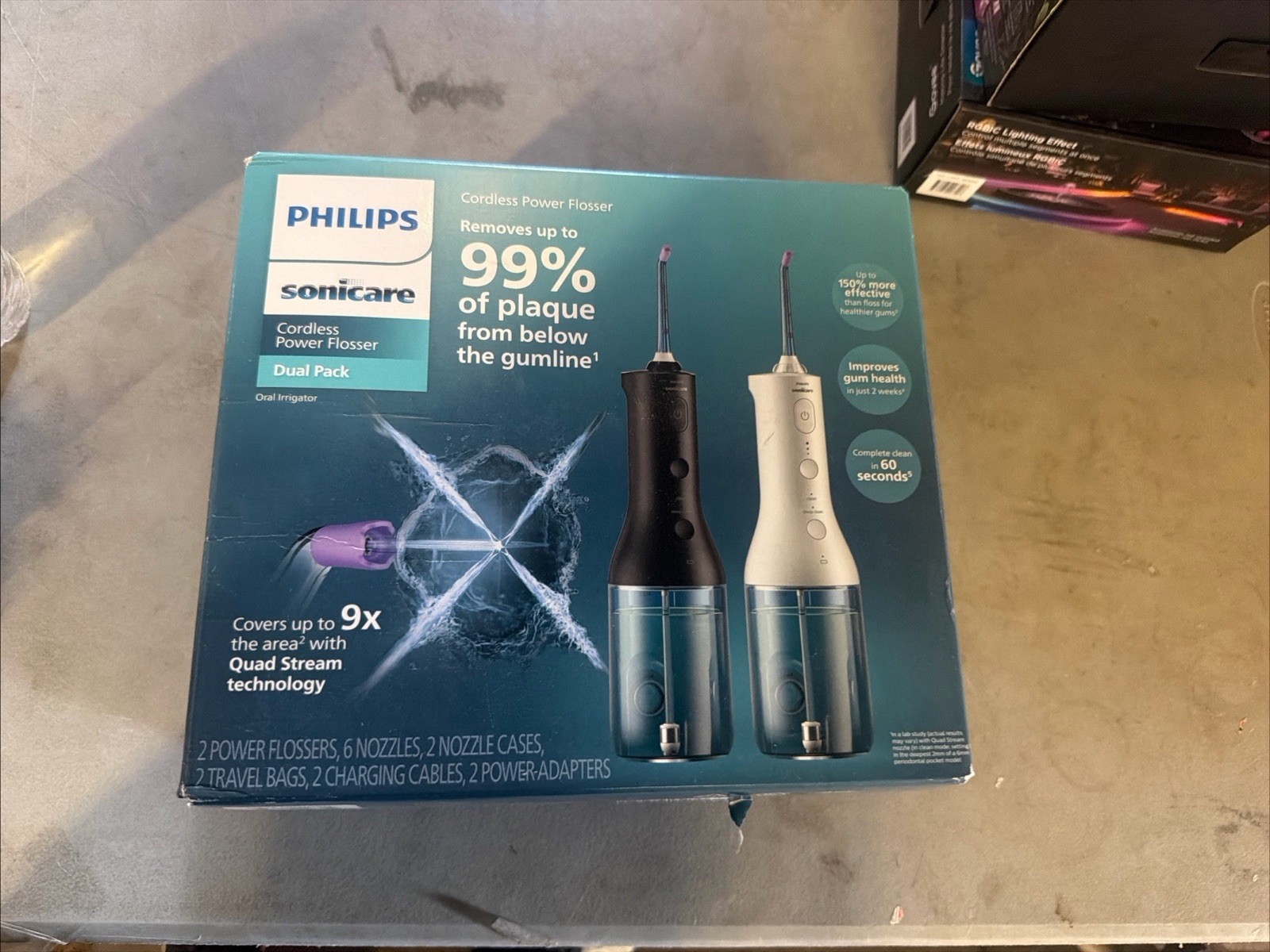

Photos from current listings. Actual item, color, and included accessories may vary.
Philip Sonicare Cordless Power Flosser Buying Guide
A cordless power flosser is a rechargeable oral irrigator that uses a pressurized water jet to clean between teeth and along the gumline where string floss can't reach, and the Philips Sonicare line is defined by its collapsing reservoir and mid-pressure pump. The core trade-off is pressure-to-portability: compact units deliver 30–60 PSI for 30–45 seconds of flossing per tank, while full-size countertop units reach 90–100 PSI and run indefinitely on AC. Buy the Philips Sonicare cordless only if you want a travel-ready jet at 45–75 PSI with a slide-collapse tank; skip it for heavy plaque, braces, or periodontal pockets that need sustained high-pressure irrigation.


At a glance
- Category
- Oral Care
- Data updated
- Nov 15, 2026
Current offers
Highlights
- Cordless Sonicare flossers run on a rechargeable NiMH or Li-ion battery with roughly 2–3 weeks of typical use per charge via USB or a two-prong plug.
- Pressure ranges from about 45 PSI on the gentlest setting to 75 PSI on high, with a 250–300 ml sliding reservoir that collapses for travel.
- The jet tip is a replaceable nozzle; standard units ship with two tips and require replacement every 3–6 months as the orifice widens and pressure drops.
- Philips Sonicare cordless models are IPX7 water-resistant and are designed to be used over a sink, not submerged in a filled basin or shower.
Best use cases
- Best fit: pick the cordless Sonicare if you travel frequently, have tight contacts or bridges, and want a 45–75 PSI jet that fits in a toiletry bag with a collapsing tank.
- Wrong fit: skip it if you have braces, implants, or periodontal pockets deeper than 4 mm — those cases need a countertop unit at 90–100 PSI with a full-liter reservoir and a rotating or targeted tip.
- Best fit: choose a dual-pack only when two household members each want their own unit and own color-coded tips; a single unit with spare nozzles is cheaper and avoids duplicate chargers.
Buying tips
- Match pressure to need: 45–60 PSI suits sensitive gums and children over 10, while 70–75 PSI is the minimum for effective plaque disruption in healthy adults with tight contacts.
- Check the reservoir math: 250–300 ml gives about 45 seconds at medium pressure, so a 45-second floss session needs one refill on most cordless Sonicare units.
- Confirm the charging standard before buying: Sonicare cordless flossers use either a USB-C cable or a proprietary two-prong base, and the base version needs a shaver socket or adapter abroad.
- Buy replacement nozzles at the same time — the jet orifice wears and pressure falls noticeably after 3–6 months of daily use, and nozzle packs are model-specific.
Specs
| Pressure Range | 45–75 PSI (cordless) |
|---|---|
| Reservoir Capacity | 250–300 ml collapsing tank |
| Battery / Runtime | Rechargeable; 2–3 weeks typical |
| Water Resistance | IPX7 (sink use, not submersible) |
Related searches
What to check before buying
- Measure your bathroom counter and shelf depth: the collapsed Sonicare unit is roughly 15–20 cm tall, so confirm it fits upright in a cabinet or cup without stressing the tank slide.
- Check your power situation: a two-prong charger needs a North American shaver outlet or plug adapter; a USB-C version recharges from any 5V USB port or power bank.
- Confirm nozzle compatibility: Sonicare cordless flosser tips are not interchangeable with countertop Sonicare AirFloss or Waterpik models, so order the matching tip style.
- Verify water temperature and quality at the tap — the reservoir fills from the sink, and hard water above roughly 180 ppm calcium scales the internal pump over time without periodic vinegar flushing.
FAQ
Data sources: eBay / Amazon listings and product attribute feeds Data updated Nov 15, 2026.
Some links on this page are affiliate links. If you buy after clicking one, we may earn a commission at no extra cost to you. This does not change which products appear here or their order. Affiliate disclosure.