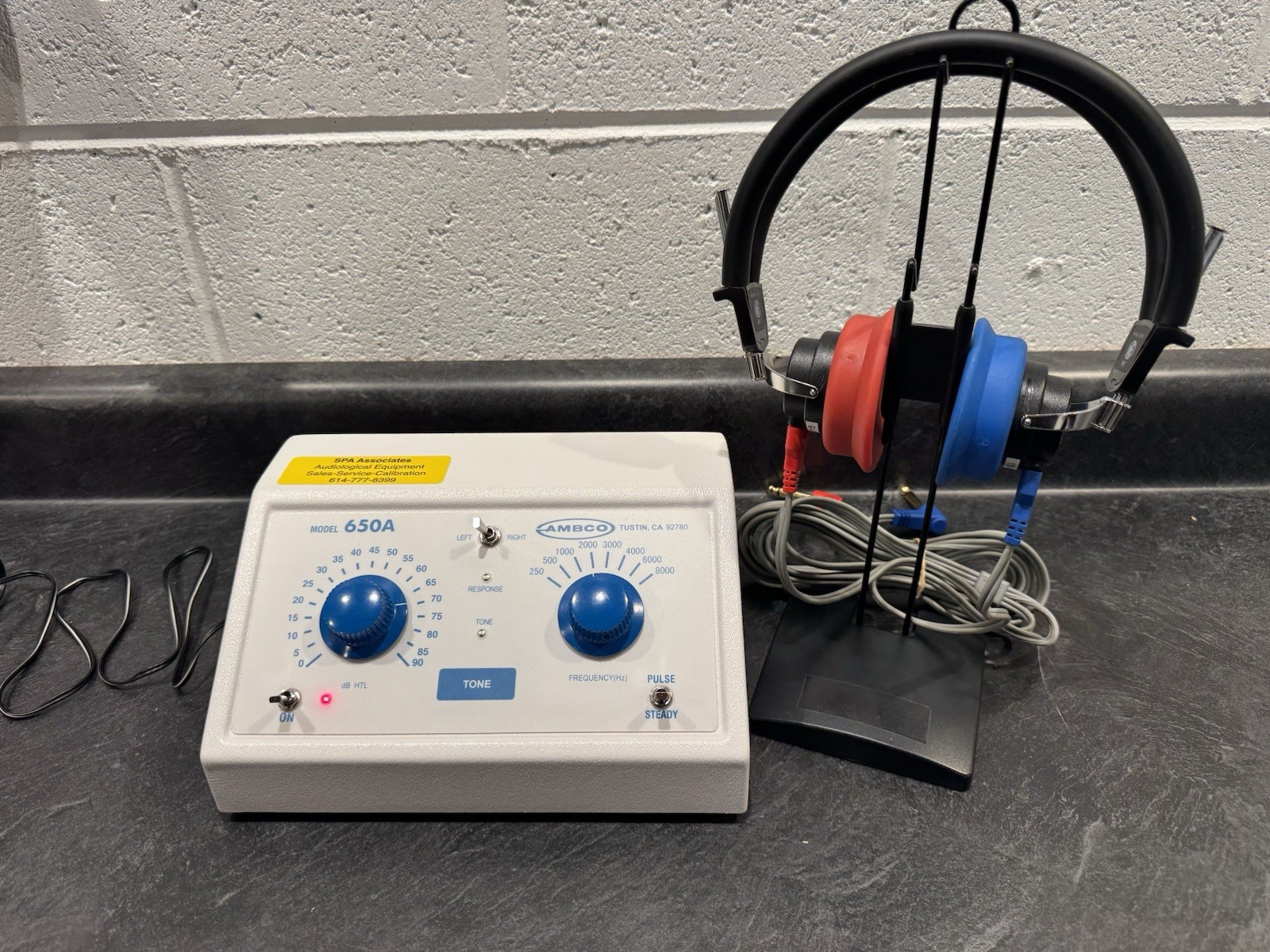

Photos from current listings. Actual item, color, and included accessories may vary.
Ambco 650A Buying Guide
The Ambco 650A is a portable screening audiometer used for basic hearing threshold testing in schools, clinics, and occupational health settings. The core trade-off is between a calibrated, durable screening device and an uncalibrated or consumer-grade hearing app. Buy only units with a current calibration certificate and verified air-conduction headphone output; skip any listing lacking documented calibration history.


At a glance
- Brand
- Not synced yet
- Model
- Not synced yet
- MPN
- Not synced yet
- Category
- Health Monitors & Medical Aids
- Status
- Offers available
- Data updated
- Nov 15, 2026
Current offers
Highlights
- The 650A is a pure-tone air-conduction screening audiometer covering the standard 250–8000 Hz range at intensities up to 90 dB HL, sufficient for pass/fail hearing screening.
- Calibration is the decisive performance factor: units must ship with a current certificate traceable to ANSI S3.6 or IEC 60645-1 standards, with annual recalibration required.
- Construction uses a rugged portable chassis with a built-in headphone jack and manual frequency/intensity controls, designed for field screening rather than diagnostic clinical use.
- It is not a diagnostic audiometer: it lacks bone-conduction testing, masking, and narrow-band noise needed for clinical threshold determination.
Best use cases
- Best fit: school nurses and occupational health technicians needing rapid pass/fail hearing screening in multiple locations — choose the 650A with a fresh calibration certificate and dedicated TDH-style headphones.
- Best fit: small clinics adding basic screening capacity — pair with a quiet room of 30 dBA or lower background noise; skip if you need diagnostic thresholds or bone conduction.
- Wrong fit: audiology practices requiring diagnostic audiometry with masking and bone conduction — choose a full diagnostic audiometer instead.
- Wrong fit: home users wanting casual hearing checks — a calibrated screening device is overkill; use a validated consumer hearing test with a smartphone and quiet room.
Buying tips
- Demand a calibration certificate dated within the last 12 months; an expired or missing certificate means the unit must be recalibrated before reliable screening.
- Verify the headphone model matches the calibration data — mismatched or generic headphones invalidate the calibration and skew thresholds.
- Check that the unit includes the power adapter and that the headphone cable and plug are undamaged; replacement cables must be sourced from the manufacturer to preserve calibration.
- Confirm the frequency and intensity ranges cover 250–8000 Hz and at least 90 dB HL; units with reduced ranges are not suitable for standard screening protocols.
Specs
| Audiometer Type | Screening, air-conduction only |
|---|---|
| Frequency Range | 250–8000 Hz |
| Max Intensity | 90 dB HL |
| Calibration Standard | ANSI S3.6 / IEC 60645-1 |
Alternatives to compare
Related searches
What to check before buying
- Measure your test room: background noise must be 30 dBA or lower for valid screening; use a sound-treated booth or quiet office.
- Confirm the unit ships with the correct headphone type (typically TDH-39 or similar) and that ear cushions are intact and clean.
- Check voltage and plug standard for your region — the 650A is available in 120 V and 230 V variants; match your mains supply.
- Ensure you have a current calibration certificate and a plan for annual recalibration with a certified lab.
FAQ
Data sources: eBay / Amazon listings and product attribute feeds Data updated Nov 15, 2026.
Some links on this page are affiliate links. If you buy after clicking one, we may earn a commission at no extra cost to you. This does not change which products appear here or their order. Affiliate disclosure.