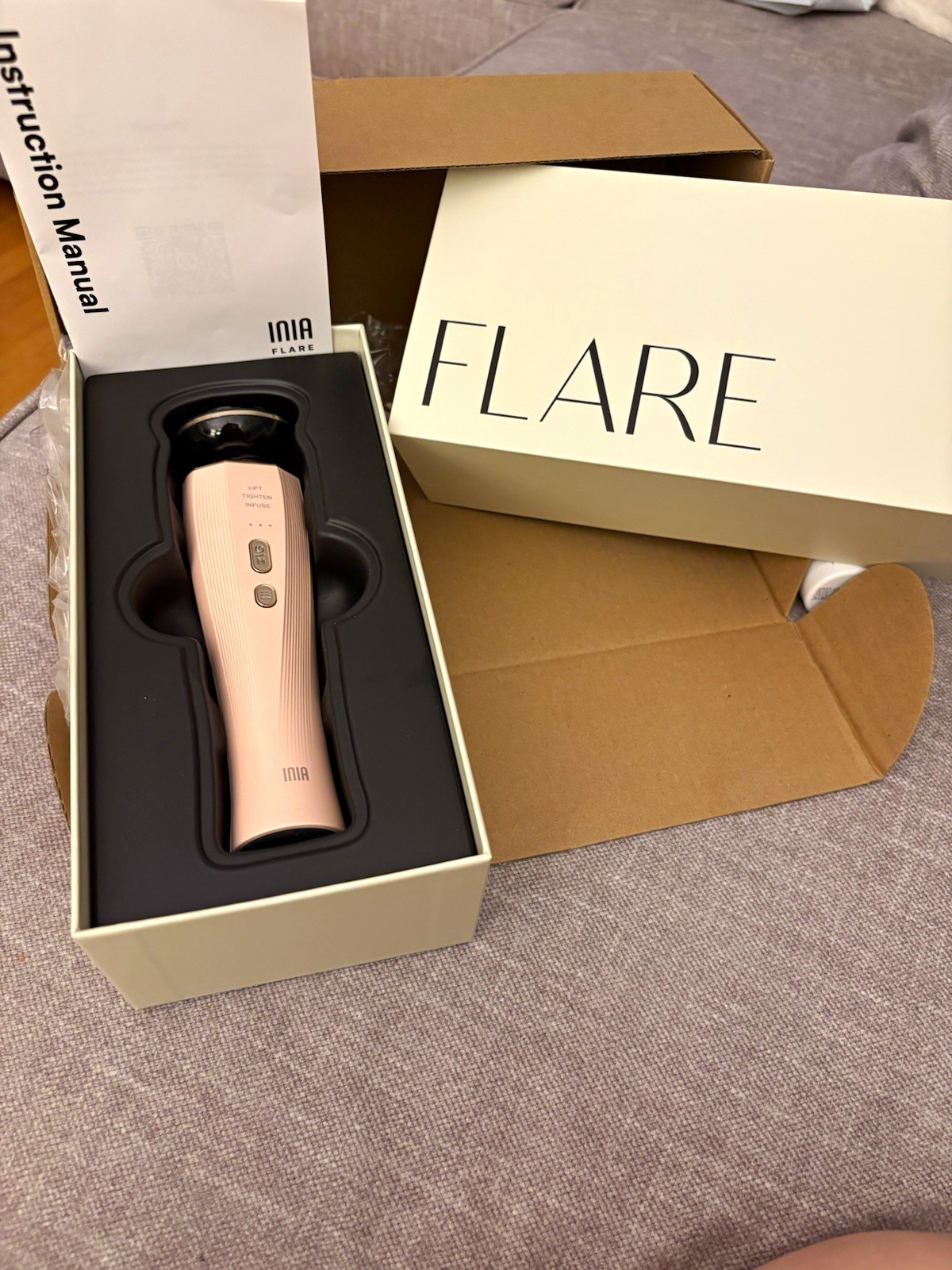

Photos from current listings. Actual item, color, and included accessories may vary.
INIA Flare Buying Guide
The INIA Flare is a handheld at-home contour treatment device that uses radio-frequency (RF) energy to heat the dermis and stimulate collagen for skin firming and wrinkle reduction. The primary trade-off is between professional-grade RF power and consumer-safe temperature controls: lower-energy devices are safer but require more sessions, while higher-energy units demand strict motion discipline to avoid burns. The decision rule is to choose a device with a real RF frequency (≥1 MHz), a skin-temperature sensor, and a corded power supply for consistent output—skip battery-only units that weaken over a session and lack thermal cutoff.


At a glance
- Brand
- Not synced yet
- Model
- Not synced yet
- MPN
- Not synced yet
- Category
- Beauty Devices
- Status
- Offers available
- Data updated
- Nov 15, 2026
Current offers
Highlights
- RF frequency of 1 MHz or higher penetrates deeper into the dermis for collagen remodeling; sub-500 kHz units treat only the epidermis and give minimal contouring.
- Built-in thermal sensors and auto shutoff at ~42°C skin temperature are mandatory safety features; devices without them rely on user timing and risk localized burns.
- Corded AC operation delivers stable RF power across the full session; battery-powered RF devices lose output as voltage drops, reducing treatment efficacy.
- Multiple treatment modes (e.g., continuous vs. pulsed) let users match energy delivery to sensitive zones like the jawline versus thicker cheek tissue.
Best use cases
- Best fit: Buy the INIA Flare or similar corded RF device if you want at-home jawline and cheek contouring with consistent energy and have 10–15 minutes per session, 2–3 times weekly.
- Wrong fit: Skip any RF contour device if you have active acne, rosacea, metal implants in the treatment area, or are pregnant—RF heat exacerbates these conditions.
- Wrong fit: Do not buy a battery-only RF device for full-face treatments; the power sag mid-session means the second half of your face gets a weaker dose than the first.
Buying tips
- Confirm RF frequency in the spec sheet: 1 MHz is the minimum for dermal heating; 2–3 MHz is common in professional-grade home devices and preferable.
- Choose a unit with a built-in skin temperature sensor and automatic shutoff; this is the single most important safety feature for at-home RF use.
- Prefer corded AC power over battery for consistent RF output; if battery is the only option, ensure it is lithium-ion and rated for at least 60 minutes of continuous use.
- Check the treatment head size: smaller heads (under 4 cm²) are better for precision areas like the nasolabial folds, while larger heads suit cheeks and jawline.
Specs
| Energy Type | Radio-frequency (RF) 1 MHz class |
|---|---|
| Power Source | Corded AC vs battery |
| Safety Features | Thermal sensor + auto shutoff |
| Treatment Head | 3–5 cm² precision vs broad |
Alternatives to compare

Related searches
What to check before buying
- Measure your treatment area and confirm the device head size covers it efficiently; a 3–4 cm² head suits jawline and cheek work, while 5 cm² or larger is for broader areas.
- Verify your electrical outlet voltage matches the device's input (100–240 V universal is ideal for travel; fixed 120 V or 230 V is region-specific).
- Check that the device includes a conductive gel or serum requirement—RF needs a coupling medium, and some units require a specific gel type.
- Confirm the device has a clear user manual with treatment time limits per zone (typically 3–5 minutes per area) to avoid overexposure.
FAQ
Data sources: eBay / Amazon listings and product attribute feeds Data updated Nov 15, 2026.
Some links on this page are affiliate links. If you buy after clicking one, we may earn a commission at no extra cost to you. This does not change which products appear here or their order. Affiliate disclosure.